


Korean Sword History & Design: Structure, Types and Evolution
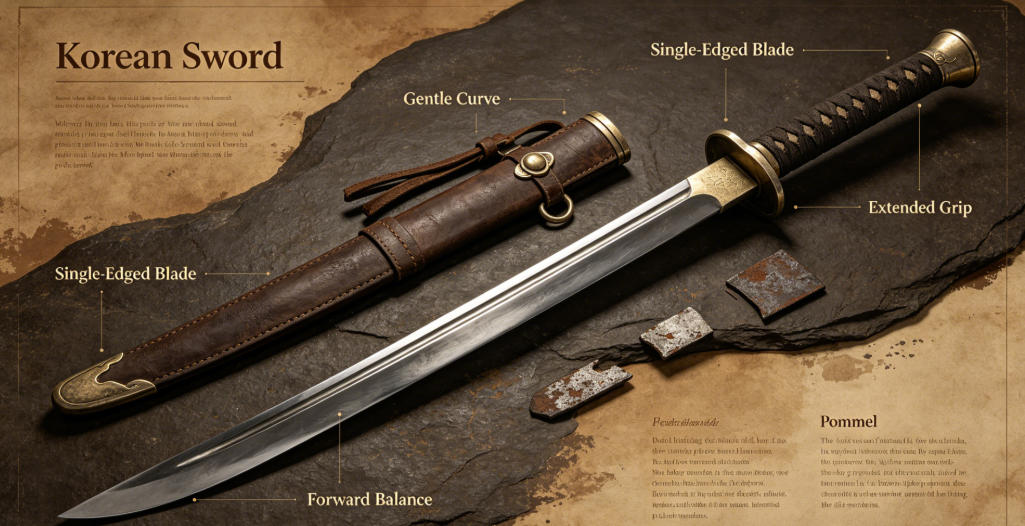
What is a Korean sword and how did it evolve in history, structure, and combat use?
In the Asian cold weapon system, the korean sword (Korean sword) and korean swords (Korean swords) occupy an important position due to their unique historical evolution and battlefield application style. Compared compared to Chinese swords and Japanese katanas, Korean swords not only absorbed multiple cultural influences but also developed their own distinct design system and combat philosophy.
As search interest in terms like 'korean sword history,' 'traditional Korean weapons,' and 'Korean sabre design' continues to rise, more enthusiasts are turning their attention to the development and characteristics of Korean weapon systems.
What is the Korean sword called?
1. Historical Origin of the Korean Sword: A Multi-Cultural Weapon System
The development of the korean sword is not a single linear evolution but the result of long-term military pressure and cultural exchange across East Asia. During the Goryeo and Joseon dynasties, the Korean Peninsula was located at the intersection of multiple military civilizations, which led korean sword (Korean sword) and korean swords (Korean swords system) to form a clear 'fusion-based weapon development path.'
In the early stage, Korean weapon systems relied heavily on Chinese military technology, especially Tang and Song dynasty sword structures and tactical concepts. These systems emphasized formation-based warfare and standardized equipment, giving early Korean swords relatively straight or lightly curved blades designed for both cutting and thrusting.
At the same time, Mongol cavalry culture from the northern steppe had a profound influence on Korean weapons. Mongol forces emphasized high mobility and mounted shock warfare, which encouraged the development of curved swords and longer blades suitable for horseback combat. As a result, some korean swords began to feature enhanced curvature and improved cutting efficiency at the blade tip, making them more effective in fast cavalry charges.
Later, Japanese katana craftsmanship also influenced Korean sword development, particularly in forging techniques and structural refinement. This included improved control of blade toughness, sharper edge optimization, and better overall balance design. These elements gradually helped the korean sword evolve toward a more balanced combination of practicality and craftsmanship.
In this multi-cultural context, Korea gradually formed a unique 'hybrid sword system.' Unlike Chinese swords that emphasize structured military formations or Japanese swords that pursue extreme cutting precision, Korean swords focus more on adaptability across different battlefield environments.
During the Joseon Dynasty, military systems became highly standardized. Weapons were officially categorized into infantry swords, cavalry sabers, and ceremonial blades, marking a shift from experience-based evolution to a formalized system. With increasing border conflicts, practical demands pushed further optimization in cutting power, grip stability, and long-term combat endurance.
Overall, the origin of the korean sword is not isolated but the result of Chinese military systems, Mongol cavalry tactics, and Japanese sword craftsmanship interacting over time.

2. Main Types of Korean Swords (Classification)
1. Single-Handed Combat Sword (Sabre-type Sword)
This type of korean sword is closer to a military weapon:
- Longer blade with slight curvature
- Focus on cutting and impact force
- Suitable for cavalry and infantry combat
👉 Common in Joseon military standard equipment
2. Two-Handed Long Korean Swords
Often seen in historical reconstructions and films:
- Longer heavy blade
- Two-handed grip for better control
- Effective against armored or multiple opponents
👉 Frequently searched as 'korean long sword'
3. Ceremonial and Ritual Swords
These korean swords are more symbolic:
- Highly decorative appearance
- Used in official ceremonies
- Represent authority and status
3. Structural Characteristics of the Korean Sword
Compared with other East Asian sword systems, the korean sword (Korean sword) shows a clear 'practical + balanced' design philosophy. It does not pursue extreme cutting efficiency like some Japanese swords, nor heavy chopping like some Chinese blades, but instead emphasizes battlefield adaptability.
1. Blade Structure
korean swords usually feature a smooth and continuous geometry:
- Mostly single-edged blades, with some transitional double-edge forms
- Moderate curvature, not overly bent
- Emphasis on smooth cutting trajectory (smooth cutting trajectory)
- Suitable for continuous attacks rather than single explosive strikes
Some advanced blades include reinforced mid-sections to improve durability during impact.
2. Balance System
A key feature of korean swords is forward-biased balance:
- Slightly forward center of gravity
- Increased momentum and cutting power
- Better penetration against armor or heavy targets
- Reduced physical fatigue through momentum-based motion
This design is especially effective in cavalry warfare, where speed already provides additional kinetic energy.

3. Hilt and Guard Evolution
The grip and guard structure evolved from simplicity to protection:
- Early designs were minimal and lightweight
- Straight grips for quick handling
- Later versions added protective guards
- Some advanced weapons used metal rings or curved guards
korean swords also often feature slightly longer grips than Japanese katanas, allowing occasional two-handed control for better stability.
Pommel balance systems are also commonly used to improve overall stability during high-speed motion.
Design Philosophy Summary
The core design of the korean sword can be summarized as:
- Efficiency of motion
- Momentum-driven cutting
- Multi-scenario battlefield adaptability
4. Korean Sword vs Katana vs Chinese Dao
- korean sword: Balanced, adaptable battlefield weapon
- Katana: High-precision single-edged cutting weapon
- Chinese Dao: Heavy chopping cavalry weapon
👉 korean swords are best described as multi-functional battlefield weapons.
5. Combat Applications
- Cavalry charge combat: high-speed cutting using momentum
- Infantry close combat: rapid continuous strikes
- Siege and terrain warfare: high adaptability in complex environments
6. Forging Techniques and Materials
Traditional korean swords often feature:
- High carbon steel forging
- Repeated folding for improved toughness
- Strong blade elasticity and durability
- Visible forging patterns on the surface
This allows korean sword to balance hardness and flexibility.
7. Cultural Significance
During the Joseon Dynasty, korean swords were not only weapons but also cultural symbols:
- Identity of warriors
- Authority symbols for officials
- Core tools for martial training
Decorative swords were often used in court ceremonies to represent rank and power.
8. Modern Replicas and Collecting Trends
With the revival of cold weapon culture worldwide, korean swords have become popular in collecting and film production.
Modern replicas often focus on:
- High carbon steel materials
- Hand-forged craftsmanship
- Historical accuracy in structure and proportions
- Cinematic visual reproduction
Collecting keywords like 'korean sword replica for sale' and 'traditional Korean swords handmade' reflect growing global demand.
9. Conclusion: The Unique Position of the Korean Sword
The korean sword is neither purely a heavy chopping weapon nor an extreme precision cutting blade. Instead, it represents a balanced battlefield system developed through continuous historical evolution.
It could adapt to cavalry charges, infantry combat, and complex terrain warfare, making it a uniquely versatile weapon in East Asian military history.

