


Scabbard vs Sheath: What Is the Difference Between Sword Sheaths?
- โพสต์โดย COOLKATANA
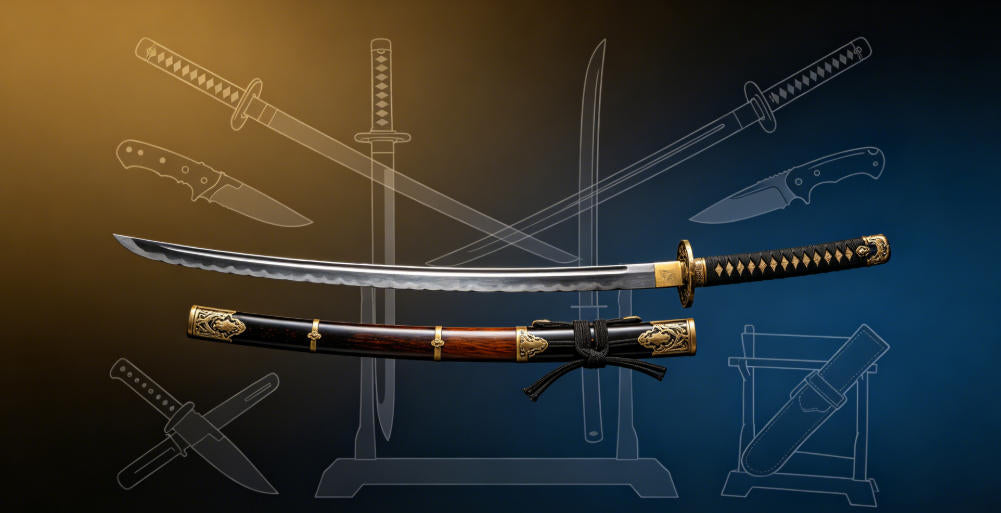
What Is the Difference Between a Scabbard and a Sheath? A Complete Guide
When learning about katana, samurai sword, or other traditional blades, many collectors come across a common question: What is the difference between a scabbard and a sheath?
Although both words can be translated as '鞘' in Chinese, they are not exactly the same in the world of blades and weapons. When people search for scabbard meaning, they are usually looking for more than just a definition. They want to understand how it differs from a regular knife cover and why traditional sword holders are commonly called a scabbard.
Likewise, when someone searches what is a sheath, they are often trying to learn the meaning of sheath and how it relates to knife and sword accessories.
Understanding these differences is especially useful when buying a Japanese sword, collecting a samurai sword, or choosing the right blade accessories.
What Is a Scabbard? Scabbard Meaning Explained
A scabbard is a protective case specifically designed for storing long-bladed weapons such as swords and large knives. From the perspective of scabbard meaning, the word represents more than just a simple cover. It refers to an important piece of equipment closely connected with traditional weapon culture.
A scabbard is usually made with a strong structure to secure the blade, prevent damage caused by impacts, friction, and environmental factors, while also allowing the user to carry and draw the weapon smoothly.
Unlike ordinary protective covers, scabbard is mainly used for historical swords, long blades, and traditional weapons. For example, medieval European sword holders, Japanese sword cases used by samurai, and modern collectible samurai sword scabbards all belong to the category of scabbards.
In traditional blade culture, scabbards are commonly used for:
- Sword scabbard: Designed to protect long swords, knight swords, and other large blades;
- Katana scabbard: Specifically made for storing Japanese samurai swords;
- Samurai sword scabbard: Refers to traditional sword holders used in Japanese warrior culture;
- Historical sword scabbard: Used for antique weapon collections and historical reproductions.
For example, the traditional scabbard used with a Japanese sword is often called a katana scabbard, while in Japanese it is known as a Saya (鞘). A traditional Saya is usually crafted from lightweight wood and carefully shaped to fit the blade. It is then finished with natural lacquer, multiple layers of coating, and decorative techniques, making it both functional protection and a valuable piece of craftsmanship.

For a true Japanese sword, the scabbard is not simply an accessory but an essential part of the sword’s overall design. In Japanese sword culture, the blade and scabbard have a close relationship.
The blade represents the strength, spirit, and skill of the samurai, while the scabbard reflects the owner’s identity, aesthetic taste, and respect for the sword.
A traditional katana scabbard needs to provide several important functions:
1. Protecting the Sharp Blade
Japanese swords are often made with high-quality steels such as:
- 1095 carbon steel katana
- T10 steel katana
- Damascus steel katana
These blades are known for their hardness and sharp edges, which require a high-quality scabbard for proper protection. A well-made scabbard prevents direct contact between the blade and external objects, reducing scratches, corrosion, and long-term storage damage.
2. Keeping the Blade Secure
A traditional scabbard is not simply a container that covers the sword. It is carefully crafted according to the shape and dimensions of the blade.
A Japanese sword scabbard is designed to ensure that the blade:
- Stays securely in place without unnecessary movement;
- Can be drawn smoothly;
- Avoids excessive friction between the blade and the inside of the scabbard.
This is why high-quality samurai sword scabbards are often customized according to the exact measurements of each blade.
3. Showcasing the Artistic Value of the Sword
Throughout Japanese history, the scabbard has been both a practical item and a work of art.
Different scabbard styles represent different cultural aesthetics, such as:
- Black lacquer scabbard: Classic and elegant, often used for traditional samurai swords;
- Red lacquer scabbard: Features a bold appearance and symbolizes strength and status;
- Wooden katana scabbard: Maintains the traditional style of Japanese swords.
Many collectors pay attention not only to blade materials, forging techniques, and sharpness but also to the quality of the scabbard, as it directly affects the sword’s display value and collectible appeal.
From a modern sword collecting perspective, a scabbard is no longer just a functional accessory. It has become an important connection between history, craftsmanship, and culture. A beautifully designed katana scabbard can fully showcase the traditional beauty of Japanese swords while allowing collectors to experience the unique heritage of the samurai era.
What Is a Sheath? Sheath Meaning Explained
So, what is a sheath?
Simply put, a sheath is a broader term than scabbard. It means a 'cover, holder, or protective case' designed to wrap and protect narrow objects from external damage.
Unlike a scabbard, which is mainly associated with swords, long blades, and traditional weapons, a sheath is not limited to the blade world. It can be used for many different objects, including tools, cables, medical equipment, and various types of knives.
In the knife industry, a sheath usually refers to a protective cover for smaller knives, such as:
- Knife sheath
- Hunting knife sheath
- Tactical knife sheath
These sheaths are commonly made from materials such as leather, nylon, Kydex, or other synthetic materials. They provide protection and secure storage depending on the intended use.
For outdoor enthusiasts, a hunting knife sheath not only protects the blade from wear but also allows the knife to be attached to belts, backpacks, or gear systems for safer and more convenient carrying. A tactical knife sheath usually focuses more on durability, quick access, and secure attachment.
Compared with traditional sword scabbards, sheaths are more commonly found in modern knife applications. Their main purpose is to protect the blade, prevent accidents, and extend the lifespan of the knife. For example, high-carbon steel knives used outdoors can be affected by moisture and environmental exposure, so using a suitable sheath helps reduce scratches, impacts, and corrosion.
Although sheath and scabbard can sometimes be used interchangeably, they have different meanings in blade culture. Generally speaking, a sheath is more commonly used for smaller knives, while a scabbard is associated with swords, long blades, and traditional weapons.
For example, a folding knife, hunting knife, or tactical knife usually comes with a knife sheath, while a Japanese samurai sword, European longsword, or historical weapon is more commonly described with terms like katana scabbard, samurai sword scabbard, or sword scabbard.
For Japanese swords, although some people may use the term katana sheath, katana scabbard is more accurate in professional sword collecting. This is because the Japanese sword scabbard is not merely a protective cover; it is an important part of traditional sword craftsmanship.
The Japanese sword scabbard is called Saya (鞘) in Japanese. It is usually made from wood and refined with lacquer, decoration, and precise craftsmanship to securely hold the blade while allowing smooth drawing movements.
Therefore, when searching what is a sheath, the answer is: a sheath is an outer protective cover used for knives or other narrow objects, commonly found in modern knife applications; while a scabbard is mainly used for swords, samurai swords, and other traditional long-bladed weapons. Although they serve similar purposes, they differ in history, usage, and cultural significance.
Scabbard vs Sheath: What Is the Difference?
Simply put:
A scabbard is more closely connected with traditional weapon culture and sword storage.
A sheath is more commonly used in modern knife and tool applications.
The main differences are reflected in their purpose and historical background.
A scabbard usually:
- Is used for swords, long blades, and samurai swords;
- Has a stronger supporting structure;
- Appears frequently in historical weapons and collectible swords;
- Represents traditional blade craftsmanship and culture.
A sheath usually:
- Is used for smaller knives;
- Has a more flexible structure;
- Focuses more on portability and convenience;
- Is common in outdoor knives and tools.
For example, a Japanese katana usually comes with an elegant wooden scabbard, while an outdoor folding knife typically uses a knife sheath.

Why Do Japanese Swords Use Scabbards Instead of Ordinary Sheaths?
In Japanese sword culture, the scabbard is not only for protection but also an important part of samurai equipment.
A traditional katana scabbard usually consists of:
- Wooden scabbard body (Saya)
- Metal decorative fittings
- Cord wrapping (Sageo)
- Protective lacquer coating
These elements not only protect the sharp blade but also allow samurai warriors to perform smooth and efficient sword drawing movements.
For Japanese swords made from high-carbon steel, such as:
- 1095 carbon steel katana
- T10 steel katana
- Damascus steel katana
A high-quality scabbard helps reduce exposure to dust, moisture, and impacts, improving both preservation and service life.
What Is the Relationship Between Katana Saya and Scabbard?
Many Japanese sword enthusiasts encounter the word “Saya.”
In reality:
Saya = the Japanese name for a katana scabbard
While:
Scabbard = the general English term for sword and blade holders
Therefore:
- Katana saya ✅
- Katana scabbard ✅
- Samurai sword scabbard ✅
All of these expressions can describe a Japanese sword sheath.
However, for collectors who want to understand Japanese sword culture more deeply, 'Saya' carries a stronger traditional meaning because it represents a specific part of the Japanese sword-making system.
How to Choose the Right Katana Scabbard?
If you are purchasing a Japanese sword or collecting anime sword replicas, choosing the correct scabbard is very important.
1. Consider the Blade Size
Different Japanese swords require different scabbard sizes:
- Katana: Standard long sword;
- Wakizashi: Shorter companion sword;
- Tanto: Japanese dagger.
The scabbard length must match the blade precisely to ensure proper fitting and smooth drawing.
2. Choose the Right Material
Common scabbard materials include:
Wooden Scabbard
Traditional wooden scabbards:
- Lightweight;
- Protective;
- Match the classic Japanese sword style.
Lacquered Scabbard
Lacquered scabbards:
- Offer a more elegant appearance;
- Are often used for collectible Japanese swords.
Leather Scabbard
Leather scabbards:
- Provide durability;
- Suit modern knife and sword styles.
Conclusion: How Should You Choose Between Scabbard and Sheath?
In summary:
A scabbard is mainly used for swords, long blades, and traditional weapons, such as katana scabbards and samurai sword scabbards.
A sheath is a broader protective cover concept, commonly used for knife sheaths and modern knife accessories.
For Japanese sword collectors, a scabbard is not just a tool for protecting the blade. It represents sword culture, craftsmanship, tradition, and the spirit of the samurai.
A great Japanese sword needs a suitable scabbard to fully reveal its value.
Blade and scabbard are two parts of the same story — the sword and its sheath together create a complete legend.

